The Best Time to Take Your Family to Tulum
Tulum has been having a hard year. If you follow travel news at all, you have probably seen the headlines: empty beaches, closing restaurants, hotels running half full in what should be high season.
Most people read that and cross Tulum off the list.
I read it and started pricing villas.
Here is what is actually happening on that coast, what it means for a family trying to get everyone in the same place at the same time, and the one thing you have to get right before you book.
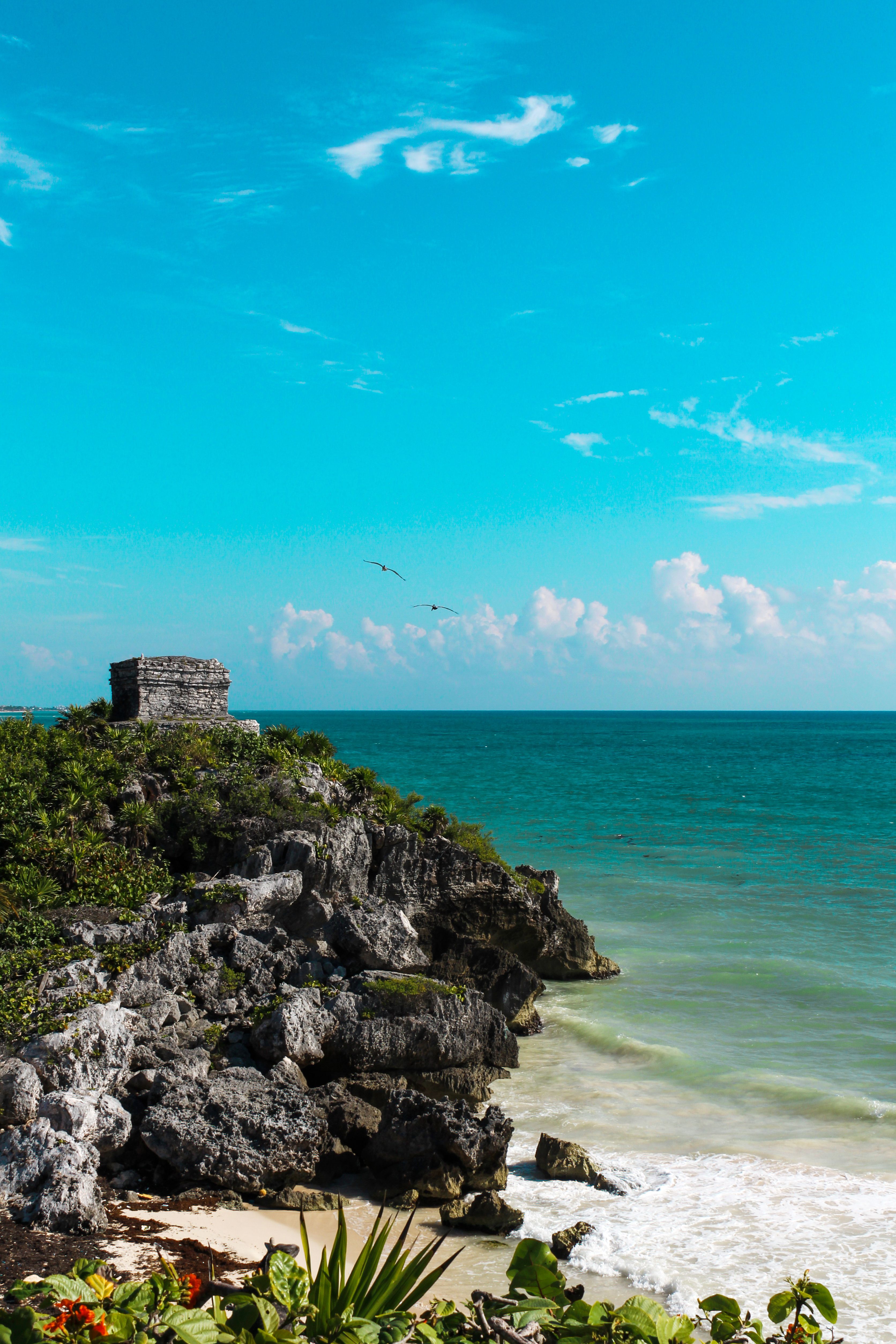
What HappenedWhat happened to Tulum
The numbers are not subtle. Quintana Roo\u2019s state tourism ministry recorded Tulum hotel occupancy falling by 17.5 percentage points in September 2025 compared with the same month the year before, from roughly sixty-seven percent down to forty-nine. Industry reporting through last summer put the coastal hotel zone near thirty percent, with the town centre lower still.
The pressure came from several directions at once. Prices in town climbed to the point where visitors felt taken advantage of, a complaint that dominated local coverage and social media. Record sargassum seaweed fouled the beaches. A new airport and a new national park changed the rules of the destination faster than anyone could adjust. Airlines responded by trimming routes, and traffic through Tulum\u2019s international airport fell sharply.
By the time Mexico\u2019s president visited Tulum in July 2026, occupancy in what should have been strong travel windows was sitting around forty percent, while Cancun and Isla Mujeres up the coast were comfortably above seventy-five.
That is the bad news, and I am not going to soften it.
The GovernmentWhat the government did about it
This is the part most travellers have not caught up on yet, and it changes the math.
In November 2025 Mexico\u2019s tourism ministry launched a recovery plan for Tulum. In July 2026 it got teeth. A federal decree cut entry to the Tulum archaeological zone by roughly half, opened general access to Parque del Jaguar, created public beach access points on a stretch of coast that had been controlled almost entirely by private clubs, and set a flat low fare for the electric shuttle inside the park. The published pricing is set to hold through 2027.
Alongside that came a package on the operational problems: a parking facility at the southern entrance, a tourist assistance model run with the National Guard, a certification programme for tourism operators, taxi fare regulation, a new public transport system, and an active campaign to win back air routes.
Meanwhile the beach cleanup went from municipal to federal. Navy crews and municipal teams were pulling well over a hundred tons of sargassum off national park beaches in a single day this summer.
A destination that had been pricing itself out of reach just had its costs cut, its beaches opened, and its infrastructure problems put on the national agenda.
The OpportunityWhy this is a group traveller\u2019s window
Softness in a destination does not help everyone equally. It helps the traveller who books the whole thing.
When occupancy falls, hotels discount rooms. That is useful if you need one room. If you need six rooms for a family spanning three generations, a resort discount still leaves you with six separate bookings, six room keys, six sets of walls between you, and a restaurant reservation problem every single night.
A private villa behaves differently. The property is a fixed cost, so the more people you bring, the less each person pays, and that curve is steep. The same house that feels expensive for ten travellers becomes very reasonable at sixteen or eighteen. Add a staffed property with a chef, a driver, and daily housekeeping included in the rate, and you have replaced the single most exhausting part of a family trip, which is deciding where eighteen people are going to eat.
The timing matters because villa inventory on this coast is competing for a smaller pool of visitors than it was two years ago. That is the entire opportunity.
And the demand is real. Recent industry surveys put multigenerational travel at roughly half of all trips being planned, with one insurance-data analysis showing a double-digit surge over the previous year. The Family Travel Association\u2019s research has parents planning trips with both grandparents and children at well over half of respondents, with extended family vacations climbing several points year over year. One UK operator reported group bookings of six or more travellers up sixty-seven percent year over year.
Families want to do this. Most of them just never get past the group chat.


The ActivitiesWhat multigenerational actually means in Tulum
The reason Tulum works for a wide age range is that the best things to do there are not physically demanding.
The float through Sian Ka\u2019an. Inside the biosphere reserve, you take a boat across the lagoons and then drift down canals the Maya cut for trade centuries ago. The current does the work. Operators are explicit that no swimming is required, and everyone wears a life vest. A grandparent and a small child can genuinely do this together, which is close to impossible to find anywhere else. Entry passes and boats are limited daily, so it needs booking ahead.
The cenotes, chosen carefully. Gran Cenote is consistently the most family-workable option near town: calm clear water, shallow areas, life jackets available, and platforms for whoever wants to jump. Dos Ojos is the cave snorkelling option for teenagers and confident swimmers. Warmer, shallower cenotes like Yax-Kin suit the youngest and oldest travellers better than the dramatic ones do.
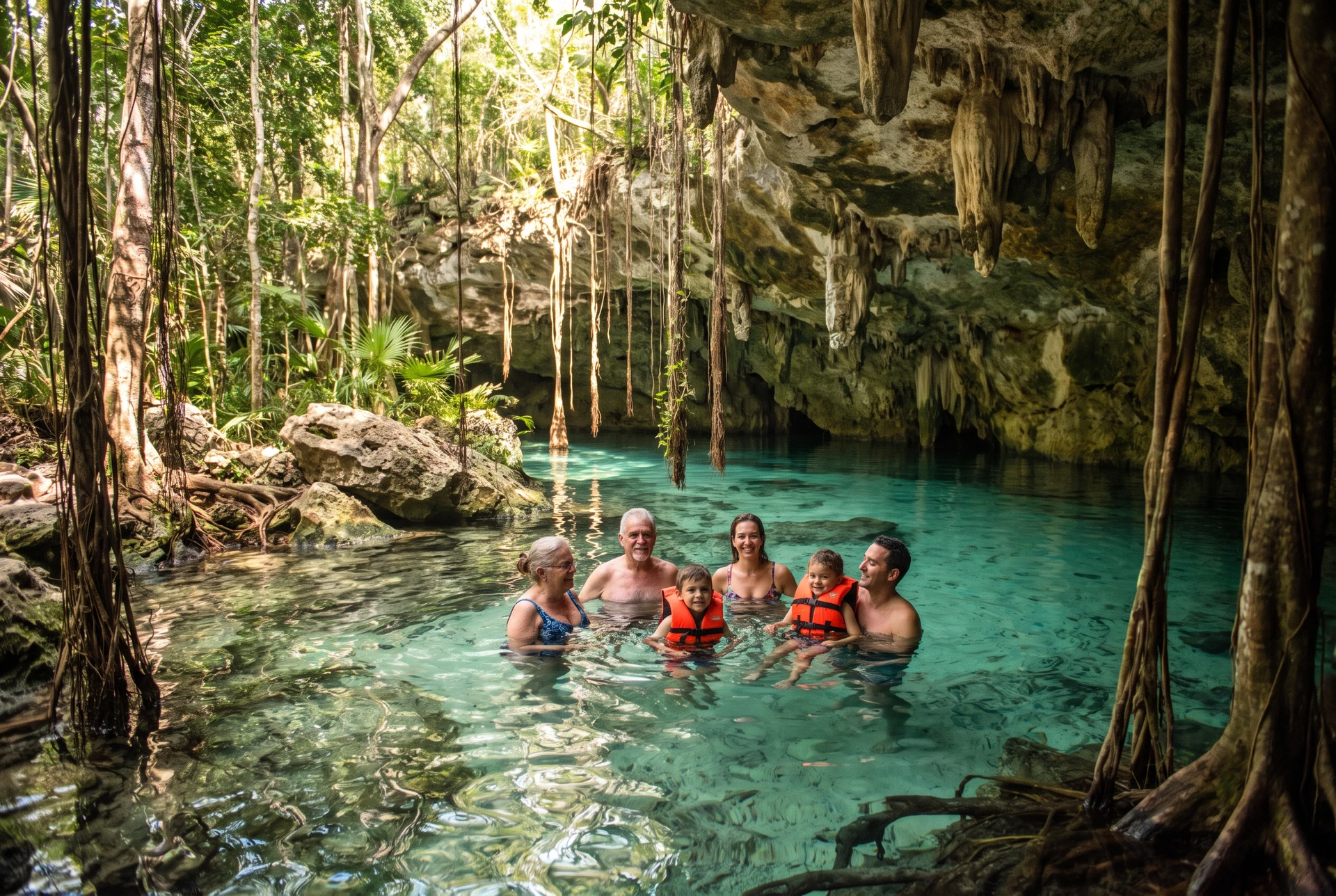
The ruins, which are mercifully compact. The Tulum archaeological site sits on a cliff directly above the Caribbean, and it is walkable in a morning rather than an endurance test. A museum has opened at the site. With the new fee structure it is now meaningfully cheaper to bring a large group through.
Akumal. Snorkelling with wild green sea turtles in the seagrass beds, with a licensed guided entry. Yal-Ku lagoon nearby is calm-water snorkelling for anyone not ready for open ocean.
Coba and Punta Laguna. Bike or pedicab through jungle paths to the ruins at Coba. Watch spider monkeys at Punta Laguna with the Maya community that manages the reserve.
Hands in the food. Village kitchen visits where you make tortillas by hand, cacao and chocolate workshops, tequila tastings. These book privately for a group and tend to be the thing the kids talk about afterwards.
The pattern worth noticing: on any given day, the group can split. The teenagers go cave snorkelling, the grandparents take the float, the parents get an afternoon, and everyone reconvenes at one table for dinner that somebody else cooked.
The One ThingThe one thing you have to get right
Sargassum.
The University of South Florida, which runs the satellite tracking the whole industry relies on, has flagged 2026 as a potential record or near-record year for Atlantic sargassum. Quintana Roo collected tens of thousands of tons in 2025. Tulum faces directly east into the Atlantic currents, which is why it gets hit harder than sheltered spots up and down the coast.
The seasonal pattern still holds even in a heavy year. Peak arrivals run roughly May through September, worst in the middle of summer. November through February are historically the clearest months, with December and January the safest bets. March and April are transitional. Early 2026 did see unusual arrivals in January and March, so nobody should promise you a flawless beach.
- Travel in the winter window if the beach matters to you.
- Choose a property with a serious pool, because it is your insurance policy.
- Build the itinerary around cenotes and the lagoon rather than sand. They are inland, they are unaffected, and they are the better experience anyway.
- Ask your advisor to check live beach conditions in the days before you fly, and to have the cenote plan already booked.
I would rather tell you this before you book than have you discover it on day two.
The VerdictSo is Tulum worth it for your family?
If you want to sit on a beach chair for seven days and see nobody, the honest answer is that there are easier choices right now.
If you want your parents, your siblings, your kids, and your cousins under one roof, eating at one table, floating down a Maya canal together and swimming in water that is clear no matter what the ocean is doing, this is one of the strongest values in the Caribbean at the moment. The destination has been discounted, the fees have been cut, the beaches have been opened, and the crowds have thinned.
Destinations do not stay in this state for long.
What It CostsWhat it costs
That depends on three things, and they move the number more than anything else: the week you choose, how many of you are coming, and where everyone is flying from. A March week prices differently from a January week. Fourteen travellers price very differently from eighteen in the same house. And a group flying out of four different cities needs the gateways priced separately.
That is the work I do. Tell me who is coming and roughly when, and I will build the real numbers for your family.
Common Questions About Tulum With Family
Is Tulum safe for families in 2027?
Tulum remains a mainstream family destination, and the federal recovery plan includes a tourist assistance model operated with the National Guard along with certification requirements for tourism operators. As anywhere, the practical answer depends on where you stay and how you move around, which is one of the things an advisor manages for you.
When is the best time to visit Tulum with kids and grandparents?
The winter window, roughly December through March, offers dry weather and historically the lowest sargassum levels. December and January are typically the clearest.
How bad is the seaweed in Tulum?
Sargassum arrives seasonally, heaviest from late spring through summer. 2025 was a record year and 2026 has been forecast as potentially record-setting. Tulum\u2019s east-facing coastline gets more than sheltered beaches do. Winter travel and a cenote-focused itinerary largely solve it.
Is a villa cheaper than a resort for a large family?
Frequently, yes, and the advantage grows with group size, because the property cost is fixed and splits across everyone. Staffed villas that include a chef and housekeeping also absorb costs a resort charges separately.
How many people can travel together in a Tulum villa?
Properties on this coast range widely. Larger staffed villas commonly accommodate mid-to-high teens in guest count, with per-person cost falling as occupancy rises.
Do we need to rent cars?
Not necessarily. Many staffed villas include a driver, and private transfers plus booked excursions usually cover a group\u2019s needs more comfortably than a convoy of rentals.
How do we get to Tulum?
Tulum\u2019s own international airport takes seasonal service in the winter window, and Cancun offers year-round options with a longer transfer. Route schedules have shifted, so current service should be verified when you book.
Occupancy, fee, and sargassum figures cited in this article were researched in August 2026 and are attributed to Quintana Roo\u2019s state tourism ministry, Mexico\u2019s federal Diario Oficial de la Federaci\u00f3n, and the University of South Florida\u2019s Optical Oceanography Laboratory as reported in the travel and regional press. Conditions and pricing change. Nothing in this article is a quotation, and no trip is confirmed until booked.
Meaningful Travel, Beautifully Planned ✦
Back to The Gatherwell Journal · See also: The Year of Traveling Together · Skip-Gen Travel · Cartagena: The March Escape